The pandemic months and the immediate aftermath accelerated what many had long predicted yet few truly expected: a seismic, if brief, upheaval in the market for innovative art. Confined to their homes, collectors and gallerists pivoted to the digital sphere, creating a stage where untested talent could, in theory, flourish beyond the constraints of tradition. But like so many booms born in the shuttered days of cultural life, this surge proved both fleeting and illusory. The feverish demand that propelled emerging artists to dizzying heights has now ebbed, exposing the market’s unyielding habit of returning to the familiar, merely disguised as novelty.
That moment, now receding in the rearview, reflected less a genuine leap in artistic quality than a symptom of the art market’s enduring structural realities. Contemporary art has long lived in paradox, championing innovation while bowing to the imperatives of liquidity and investment security. As a result, a new generation of artists remains suspended in a precarious limbo: too fresh to command institutional authority, too volatile to promise financial return. The pandemic’s digital interlude, far from dismantling hierarchies, recast them, replacing the intimacy of physical salons with algorithmic gatekeepers whose criteria for visibility tilt toward spectacle over substance.
The irony is sharp: a sector built on aesthetic risk now finds itself hostage to the metrics of digital capitalism, where platforms engineered for engagement reward art that dazzles or shocks over work whose meaning unfolds slowly. In this environment, the very ambition to innovate can reduce art to little more than a distraction, a commodity quickly consumed and forgotten.
The recent market retreat is more than a correction; it is a pointed reminder of the deep tension between the unhurried rhythms of art and the market’s relentless impatience. What once shimmered as a radiant digital utopia for emerging talent now reads as a mirage. The brutal calculus endures: visibility is transient, attention is scattered, and institutional backing remains indispensable. The old hierarchies have not fallen; they have merely evolved.
Yet this is not a nihilistic epitaph for creative innovation. On the contrary, it sharpens the imperative to reimagine the frameworks that sustain it. The real challenge lies in building spaces, both critical and commercial, where emerging artists can endure beyond the dictates of market logic. Such a project demands patience, depth, and a refusal to equate value solely with novelty.
The pandemic’s artistic bloom was dazzling but short-lived, a glimpse of what a democratized, fluid ecosystem hungry for new forms might have been. Its abrupt end laid bare an enduring truth: the art market is less a meritocracy than a mirror of broader cultural and economic forces. The rise and fall of experimental creative forms remains a cautionary tale about the limits of digital disruption and the resilience of entrenched hierarchies cloaked in the rhetoric of innovation.
Any future in which art genuinely earns the mantle of innovation will depend less on the market’s fleeting whims and more on a shared commitment to cultivation over consumption, a commitment as intellectual as it is financial. Only then might the market’s surgical spotlight give way to the steady glow of a true artistic ascent.
Four days before his 79th birthday, American filmmaker David Lynch passed away, leaving behind a legacy that cements him as a cinematic master. His name will forever grace the chronicles of filmmaking history, not only for his direction but also for his contributions to music and his role in shaping the themes that defined his works. Yet Lynch was more than a director, actor in some of his projects, and composer. He was also a painter whose significant contributions to the visual arts may not be as widely recognized, as the towering shadow of his cinematic genius often eclipses his other artistic endeavors. Art history, which often clings to conventional classifications, sometimes struggles to embrace creators like Lynch who defy easy categorization.
Lynch’s artistic journey encompassed a labyrinthine narrative of experimentation across various formats, blending film, painting, and other creative pursuits into a singular, captivating oeuvre. This synthesis resists simple labels, as his legacy – marked by films that evoke profound emotions, enigmatic paintings, and incisive cultural critiques – reveals a mind constantly pushing the boundaries of form and meaning.
The Fusion of Film, Art, and Identity
Lynch’s late-career resurgence in film elicited mixed reactions from audiences. The much-anticipated return of “Twin Peaks” in 2017 divided critics and fans alike, as it grappled with recapturing the enigmatic magic of the original 1990-91 series. His last feature-length film, “Inland Empire” (2006), baffled viewers with its surreal structure, signaling a creative exhaustion with his once-celebrated cinematic language. Similarly, Lynch’s 2017 short film “What Did Jack Do?”, a noir-style interrogation of a monkey, leaned more toward absurdist experimentation than profound expression. These diversions reflected his restless search for fresh creative equivalents to his inner turbulence.
Turning away from the film, Lynch returned to his first love – painting. This shift also coincided with his engagement in other activities, such as coffee production and transcendental meditation, a practice he credited with transforming his emotional life and extinguishing his innate anger. Lynch’s autobiography “Room to Dream” co-written with Kristine McKenna, offers a glimpse into the man behind the mystery, documenting his journey through a meditative reflection on personal and artistic evolution.
Born in 1946 in a modest family in Missoula, Montana, Lynch’s upbringing offered no indication of the dark, violent, and surreal worlds he would later depict. His childhood, marked by frequent moves due to his father’s career, painted a picture of suburban normalcy that he would later deconstruct in films like “Blue Velvet” and the series “Twin Peaks”, yet his metaphysical perspective on identity and creativity, as described in his autobiography, suggests that much of who we are is shaped before birth, embedded in the cycles of existence.
Painting as a Parallel Universe
Lynch’s visual art offers a compelling counterpoint to his film work, embracing greater ambiguity and abstraction. The 2014 exhibition “David Lynch: The Unified Field” at the Pennsylvania Academy of the Fine Arts (PAFA) showcased nearly 90 pieces, providing a rare glimpse into the breadth of his artistic expression. The exhibition revealed not only the depth of his creative oeuvre but also his ongoing dialogue with art history and contemporary visual culture.
His paintings are often surreal, violent, and darkly humorous, mirroring the tone of his films while maintaining their own independent identity. Works such as “Boy Lights Fire” (2010) and “I Didn’t Know Gun Was Loaded, Sorry” (2005) possess a childlike yet potent quality, reflecting an instinctive and emotional approach to creativity. These pieces reject the polish and narrative structure often associated with a film, thriving instead on raw emotion, textural clashes, and the unexpected interplay of text and image.
One increasingly evident aspect of Lynch’s visual art is his distinctive integration of text, a feature that adds layers of meaning while disrupting the viewer’s sense of coherence. In the piece “My Head is Disconnected” (1994–96), the juxtaposition of a human form with a camera in place of a head and the inclusion of cryptic phrases evoke Magritte’s “The Treachery of Images”. This destabilization of language and imagery reflects Lynch’s broader fascination with how we construct meaning in an inherently chaotic world. His frequent assertion that he views a film as a “moving painting” underscores the profound interconnectedness of his artistic pursuits.
Themes of Gender and Violence
Central to Lynch’s body of work – both in film and visual art – is his preoccupation with gender, passion, and violence. His films often critique normative gender roles, exposing their raw, sometimes grotesque underpinnings. They depict wounded male sexuality descending into psychosis, while female characters frequently bear the brunt of male aggression. These dynamics are explored not to glorify them but to lay bare the violence embedded in cultural and familial structures.
In contrast, Lynch’s paintings address these themes more subtly and ambiguously, devoid of the soundscapes and narrative arcs of his films. His visual art focuses on primitive scenes of destruction and danger, as seen in recurring motifs like fire (Boy Lights Fire) and morbid figures that evoke chaos and uncontrolled vigor. Gender remains a central concern, with many works examining male aggression and the objectification of women. Yet, the static nature of these pieces invites a more contemplative engagement with these themes, allowing viewers to explore their interpretations rather than being guided by a cinematic narrative.
The Painter in Context
Lynch’s early work as a painter, such as “Drawing for Eraserhead” (1965–68), reveals a direct connection between his visual art and his filmmaking, even though he insists on separating the two. His ability to construct dream-like worlds and unsettling images in film stems from the same artistic instincts that shape his paintings.
His artwork carries a raw, unembellished quality that provides an unfiltered glimpse into the subconscious. Unlike his films, which are the result of careful planning, his visual works remain isolated, spontaneous acts of creation. It is precisely this freedom to distinguish creative processes that allowed him to approach his chosen themes in an unconstrained manner. His works often depict distorted human figures, disturbing landscapes, and recurring motifs such as fire, machinery, and deformed creatures – elements that come together to create a grotesque beauty that is both repellent and fascinating, reflecting the emotional intensity found in his films.
Lynch’s combination of techniques further enhances the tactile quality of his images, as he uses materials like cardboard, plaster, and found objects, adding depth and texture to his works, thus blurring the boundaries between painting and sculpture. This tactile quality gives his works a physical presence, enabling viewers to confront the materiality of the images alongside their symbolic meaning.
Text as a narrative tool
One of the most intriguing aspects of Lynch’s paintings is his frequent use of text. Rather than clarifying the images, his handwritten expressions often deepen their ambiguity. Some phrases create a sense of narrative tension, leaving the story unfinished. The words written on his drawings function as fragments of dreams whose meaning is hinted at but never fully revealed.
This interaction between text and image most often evokes a sense of unease, as though the viewer is being drawn into a private, incomprehensible world. Lynch’s ability to combine the banal with the terrifying reflects his fascination with the duality of human existence. This tension, present in most of his works, underscores his belief that beauty and fear are inextricably linked.
Although Lynch’s paintings have not achieved anywhere near the level of fame as his films, their influence on contemporary art is undeniable. His work resists direct comparisons with other artists in the realms of film and painting, as it embodies a unique style and exhibitions like “The Unified Field” (2014) have helped place his paintings within the broader context of modern art, highlighting their contribution to the dialogue between abstraction and figuration.
Lynch’s persistence in pursuing painting alongside filmmaking reveals his unwavering dedication to exploring the depths of the imagination, regardless of the medium. In both his films and paintings, he invites the audience to embrace discomfort, confront the surreal, and find meaning in chaos. By creating according to the original principle that the more something is unknown, the more beautiful it is, he affirms this belief through both his films and his paintings, ensuring that his legacy endures, no matter the form of artistic expression.
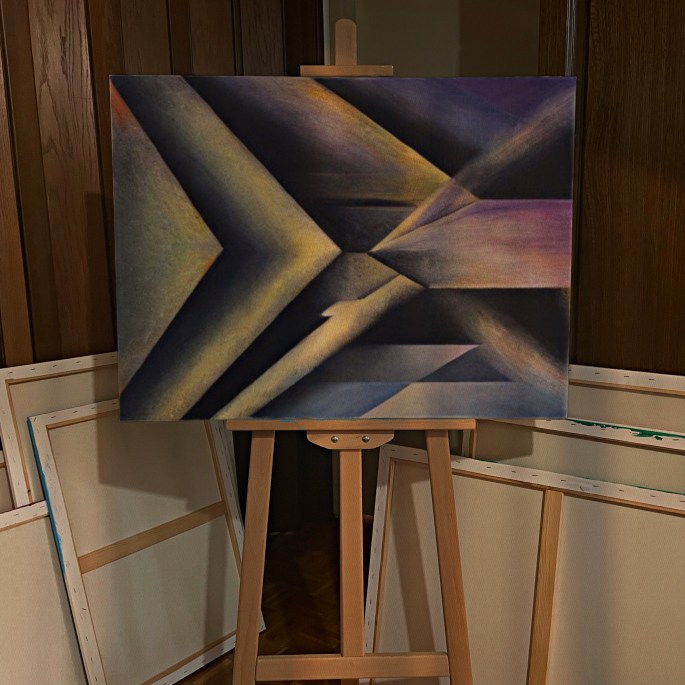
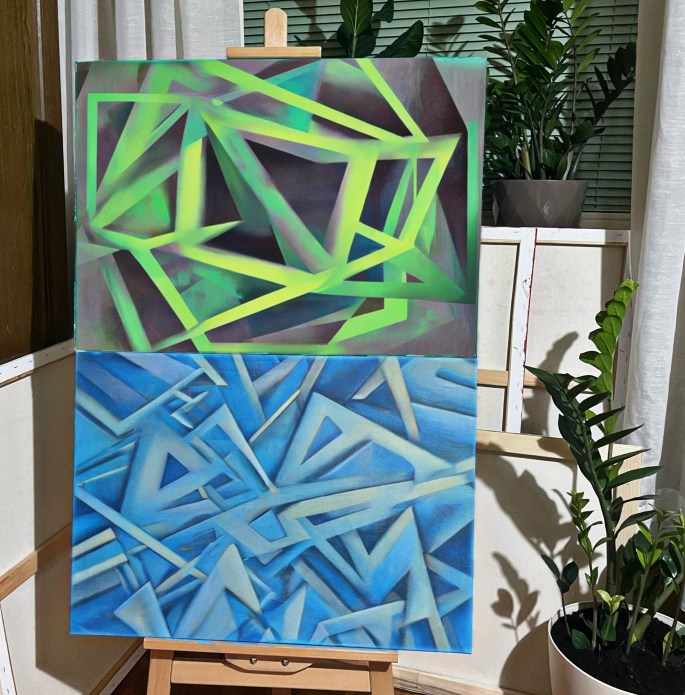
In geometry, this is a type of bijective map that preserves the algebraic structure of a field. Here is the process observed through the movement of triangles in parallel planes. Galois automorphisms are important in Galois theory, which is a branch of algebra that examines the relationship between field extensions and groups.
Hilbert’s Twenty-First Problem Oil on canvas 50 cm x 70 cm
Price: 3.294 EURSold
The parallel postulate, which is related to Hilbert’s 21st problem, is often used in the study of triangles to prove results such as the sum of the interior angles of a triangle.
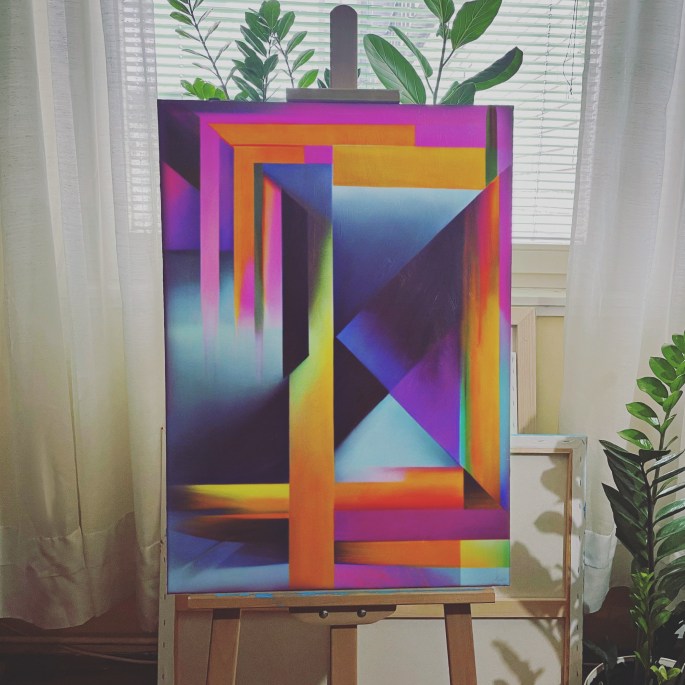
Euler’s Inequality Poncelet’s Porism
Oil on canvas 70 cm x 50 cm
Price: 3.162 EUR Price: 3.173 EURSold
Euler’s inequality is a fundamental result in geometry that applies to triangles where the sum of the squares of the lengths of the sides of a triangle is greater than or equal to four times the square root of three times the area of the triangle.
According to Poncelet’s porism, if two triangles are such that each has an incircle that is tangent to all three sides of the triangle, then any circle that is tangent to one of the triangles’ incircles is also tangent to the other triangle’s incircle.
These works are a part of the math-art project “The Power of a Triangle”. The triangle is the only plane figure described by a finite number of straight-line segments where all dots are directly connected. Out of all polygons, only a triangle is always rigid.
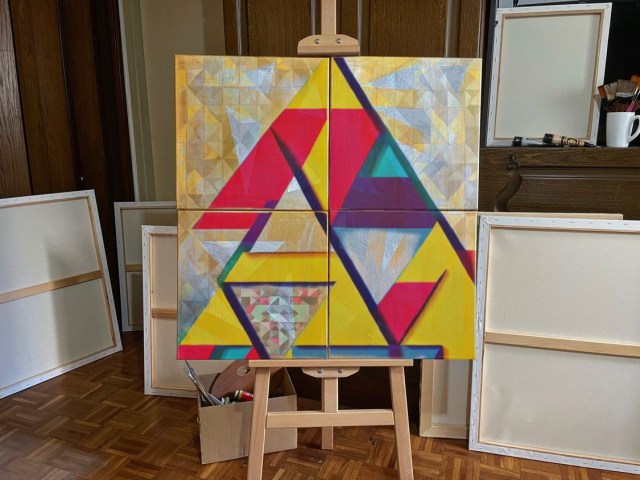
A sneak peek of my next project named “The Power of a Triangle”.
Oil on four out of 17×7 canvases connected as a whole, to be displayed 17 times in 2023.
The triangle is the only plane figure described by a finite number of straight-line segments where all dots are directly connected. Out of all polygons, only a triangle is always rigid.
Sierpiński triangle is a fractal attractive fixed set and the foundation for tetrix. By randomly selecting any point inside this triangle and connecting it to the vertex point inside you can create a chaos game.
As you all know from cryptography, regardless of the amount of data you feed into a formula, hashes are always the same length.
Just like these canvases, the element is worth more if it belongs to the relevant set. Also, meeting halfway will be a measurable step toward success.
While Sierpiński Triangl is equilateral, this isosceles triangle 17x7x17 will form the A letter as a symbol of 2023. And that A is for Art of the following year – connected and sharp.
 ananives.art